



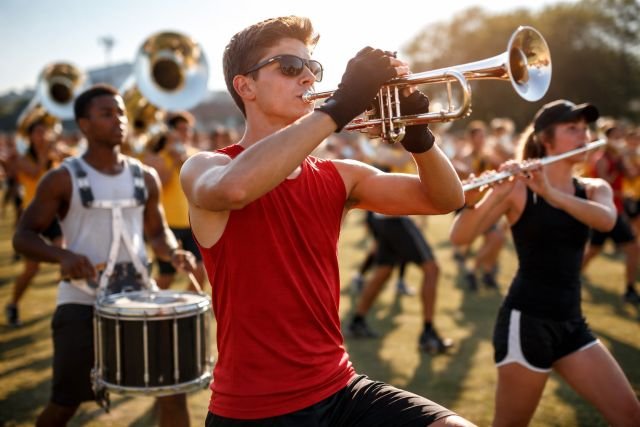
The debate around “is band a sport” has been ongoing for decades. Some people see marching band as purely musical performance, while others argue that the intense physical demands make it comparable to traditional sports. When you look closely at what marching band members actually do — marching miles while carrying heavy instruments, maintaining perfect formation, and performing complex music — the answer becomes far more interesting.
- What Defines a Sport?
- The Physical Demands of Marching Band
- Endurance and Cardio Training in Marching Band
- Coordination, Precision, and Mental Focus
- The Competitive Side of Marching Band
- Injuries and Physical Strain in Marching Band
- Teamwork and Discipline
- Why Some People Say Band Is Not a Sport
- Why Many Experts Say Band Is a Sport
- Case Study: Drum Corps International Athletes
- FAQs: Is Band a Sport?
- Conclusion: Is Band a Sport?
Marching band requires endurance, coordination, discipline, and teamwork. In fact, many studies show that the physical effort required during a marching band performance rivals that of competitive athletics. So the real question may not be “is band a sport?” but rather why it has taken so long for marching band to be recognized as one.
In this article, we’ll break down the physical, competitive, and athletic aspects of marching band to understand whether it truly qualifies as a sport.
What Defines a Sport?
Before answering “is band a sport,” it’s important to define what a sport actually is.
Most sports share several core characteristics:
- Physical exertion and endurance
- Structured competition
- Skill development and training
- Team coordination and strategy
According to the Council of Europe’s definition of sport, sports involve “all forms of physical activity which, through casual or organized participation, aim at improving physical fitness and mental well-being.”

When we compare marching band to these criteria, the similarities become clear.
Marching band involves intense physical activity, structured competitions, and coordinated team performance. Students train for months, sometimes practicing multiple hours every day during band camp and rehearsal seasons.
This immediately raises the question again: is band a sport if it meets many of the same criteria?
The Physical Demands of Marching Band
One of the strongest arguments supporting the idea that band is a sport comes from the intense physical effort required during performances.
Marching band members don’t simply stand and play music. They perform synchronized movements across large fields while carrying instruments that can weigh anywhere from 3 to over 40 pounds.
For example:
- Trumpet: around 2–3 pounds
- Mellophone: around 4 pounds
- Baritone: about 6–7 pounds
- Sousaphone: up to 40 pounds
Carrying these instruments while marching at precise tempos requires substantial strength and stamina.
Researchers at Indiana University found that heart rates of marching band members during performances can reach levels comparable to moderate-to-vigorous exercise.
Many marching band shows last 8–12 minutes, but rehearsals can last several hours under hot conditions.
Band members must maintain posture, breath control, and precise footwork throughout the performance. This combination of musical and physical coordination is extremely demanding.
Endurance and Cardio Training in Marching Band
Another important factor in the “is band a sport” discussion is cardiovascular endurance.
Marching band performances require continuous movement across football fields while playing instruments that demand strong lung capacity.
Some band directors estimate that members march 1–2 miles during a single rehearsal session.
This level of activity resembles conditioning drills used in traditional sports such as soccer or football.
Additionally, musicians must control their breathing while maintaining tone quality. Wind players in particular develop strong respiratory control similar to endurance athletes.
According to the American College of Sports Medicine, sustained physical activity combined with breath control significantly increases aerobic capacity.
This explains why many band members report improved stamina and physical fitness throughout the marching season.
Coordination, Precision, and Mental Focus
Marching band requires an extraordinary level of coordination.
Members must simultaneously:
- Play complex musical passages
- Maintain exact spacing and formations
- Follow a conductor or drum major
- Adjust movement based on tempo changes
All of this happens while performing choreographed drills across a football field.
Unlike many sports where players react instinctively, marching band requires precision timing measured down to individual steps.
One small mistake can throw off an entire formation.
This level of coordination is often compared to synchronized sports such as:
- Gymnastics
- Figure skating
- Competitive dance
In fact, marching band combines elements from all three.
The Competitive Side of Marching Band
Another key part of answering “is band a sport” lies in the competitive structure of marching band.
Many marching bands participate in organized competitions throughout the season.
Examples include:
- Bands of America competitions
- Drum Corps International (DCI)
- State marching band championships
These competitions involve judges scoring bands on several criteria, including:
- Music performance
- Visual performance
- General effect
- Precision and execution
Scores determine rankings and championships, similar to competitive athletics.
Drum Corps International in particular operates at an elite level where performers train for months and tour nationally.
DCI performers rehearse 8–12 hours per day, demonstrating the intense athletic commitment required.
Injuries and Physical Strain in Marching Band
Another point often overlooked in the “is band a sport” debate is the risk of injury.
Marching band members can experience physical strain similar to athletes.
Common injuries include:
- Stress fractures from repetitive marching
- Back and shoulder strain from heavy instruments
- Heat exhaustion during summer rehearsals
- Knee injuries from marching technique
According to sports medicine specialists, marching band injuries often resemble those seen in endurance sports.
Many schools now encourage band members to stretch, hydrate, and cross-train to prevent injuries.
These preventative measures mirror the practices used by traditional sports teams.
Teamwork and Discipline
Like any sport, marching band depends heavily on teamwork.
Each member plays a specific role within the ensemble. One person stepping out of alignment can disrupt the entire formation.
Success requires:
- Trust among members
- Consistent practice
- Communication with section leaders
- Commitment to group performance
This team dynamic is very similar to sports such as football or basketball, where coordinated effort determines success.
Marching band members also follow strict rehearsal schedules and performance expectations.
Band camps often involve 10–12 hour practice days, demanding both physical and mental resilience.
Why Some People Say Band Is Not a Sport
Despite the athletic demands, some people argue that marching band should not be considered a sport.
Their reasoning often includes:
- The primary focus is music rather than competition
- Not all bands participate in competitions
- Judging is subjective rather than objective scoring
These arguments highlight the unique nature of marching band.
It blends elements of art, music, performance, and athletics.
For this reason, some experts categorize marching band as a performing sport or athletic art form rather than a traditional sport.
Why Many Experts Say Band Is a Sport
Supporters of the idea that band is a sport emphasize the athletic aspects.
Marching band includes:
- Physical training
- Competitive structure
- Strategy and coordination
- Teamwork and endurance
These qualities align closely with many recognized sports.
In fact, activities like cheerleading, dance, and figure skating were once debated in the same way but are now widely recognized as athletic disciplines.
Marching band shares many of the same characteristics.
Case Study: Drum Corps International Athletes
Drum Corps International provides one of the clearest examples of how marching band can function as a sport.
DCI performers:
- Train intensely for months
- Travel nationwide for competitions
- Perform complex choreographed shows
- Maintain peak physical condition
Members often describe their experience as a combination of:
- professional music performance
- athletic training
- theatrical production
The physical conditioning required for DCI shows demonstrates how demanding marching band can be.
FAQs: Is Band a Sport?
Is marching band physically demanding?
Yes. Marching band requires stamina, coordination, and strength. Members march long distances while carrying instruments and performing music simultaneously.
Why do people debate whether band is a sport?
The debate exists because marching band blends music performance with physical activity. Some people focus on the artistic aspect, while others emphasize the athletic demands.
Do marching band members train like athletes?
In many cases, yes. Band members attend rigorous rehearsals, participate in conditioning exercises, and practice for long hours throughout the season.
Are there professional marching band competitions?
Yes. Organizations like Drum Corps International and Bands of America host national competitions where ensembles compete for championships.
Conclusion: Is Band a Sport?
So, is band a sport?
When you examine the physical demands, competitive environment, and level of discipline required, marching band shares many of the same characteristics as traditional athletics.
Members train extensively, perform physically demanding routines, and compete at high levels of precision and teamwork.
While marching band also remains an artistic performance, its athletic elements cannot be ignored.
In reality, marching band exists at the intersection of music, performance, and sport.