



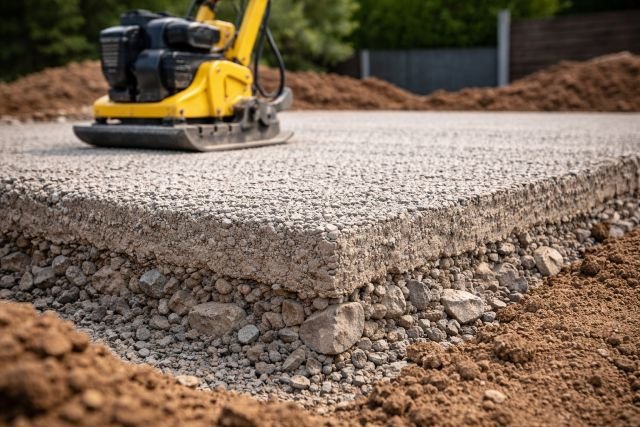
A compacted gravel base is one of the most important elements in creating long-lasting surfaces such as driveways, patios, walkways, and roads. Whether you’re installing asphalt, concrete, or pavers, the strength and durability of the finished surface largely depend on the quality of the base beneath it.
- What Is a Compacted Gravel Base?
- Why Surface Cracks Often Start Below the Surface
- How a Compacted Gravel Base Prevents Cracks
- Ideal Thickness for a Gravel Base
- Best Materials for a Strong Gravel Base
- The Role of Proper Compaction Equipment
- Real-World Example: Driveway Failure vs Proper Installation
- Actionable Tips for Installing a Compacted Gravel Base
- Frequently Asked Questions
- Conclusion
Many cracks, potholes, and uneven surfaces develop not because of poor surface materials but due to improper base preparation. When the foundation isn’t stable, the top layer eventually shifts, settles, and deteriorates.
A properly prepared compacted gravel base provides stability, drainage, and load distribution — three factors that significantly reduce the risk of structural damage. In this guide, we’ll explore how gravel compaction works, why it matters, and how it protects surfaces from cracking and long-term deterioration.
What Is a Compacted Gravel Base?
A compacted gravel base is a layer of crushed stone or gravel that is compressed tightly before installing the final surface material. The compaction process removes air gaps between particles, creating a dense, stable layer capable of supporting heavy loads.
This base layer typically consists of crushed aggregate materials, such as:
- Crushed limestone
- Granite aggregate
- Recycled concrete aggregate
- Road base gravel
When properly compacted using mechanical equipment like plate compactors or rollers, the gravel forms a strong structural foundation.

According to the Federal Highway Administration, well-compacted aggregate layers significantly improve load distribution and reduce pavement deformation over time.
Without proper compaction, gravel remains loose, allowing movement that eventually leads to cracks in the surface above.
Why Surface Cracks Often Start Below the Surface
Surface damage rarely begins at the top. Instead, it typically originates beneath the pavement or concrete slab.
When the base underneath shifts, settles unevenly, or retains water, the surface layer is forced to adapt to those movements. Over time, stress builds within the material, causing fractures.
Common problems caused by poor base preparation include:
- Settlement and sinking
- Water accumulation
- Frost heave
- Uneven weight distribution
- Structural fatigue
A compacted gravel base prevents these issues by creating a stable platform that resists movement and disperses loads evenly.
How a Compacted Gravel Base Prevents Cracks
1. Provides Structural Stability
One of the primary benefits of a compacted gravel base is structural stability.
When gravel is compacted properly, the particles interlock tightly, forming a solid platform capable of supporting heavy loads without shifting.
For example, a driveway supporting vehicles experiences significant downward pressure. If the base is loose, the surface layer absorbs most of that pressure and eventually cracks.
A compacted base spreads the load across a wider area, reducing stress on the surface layer.
This principle is commonly used in road construction and highway engineering, where multi-layer aggregate bases prevent pavement fatigue.
2. Improves Load Distribution
Another critical function of a compacted gravel base is distributing weight evenly across the ground.
Without a solid base, concentrated loads from vehicles or heavy equipment can cause localized pressure points. These stress points eventually create cracks or depressions.
When gravel is compacted:
- The load spreads across multiple stones
- Pressure disperses evenly
- Structural strain decreases
This helps extend the lifespan of driveways, sidewalks, patios, and roads.
The National Asphalt Pavement Association (NAPA) notes that proper base compaction is essential for preventing premature pavement failure.
3. Enhances Drainage and Prevents Water Damage
Water is one of the most destructive forces affecting paved surfaces.
Poor drainage allows moisture to accumulate beneath the surface. Over time, this leads to erosion, soil softening, and structural instability.
A properly designed compacted gravel base improves drainage by allowing water to flow through the aggregate rather than pooling beneath the surface.
This prevents:
- Soil saturation
- Freeze–thaw expansion
- Erosion beneath the pavement
- Surface cracking caused by moisture pressure
In colder climates, drainage becomes even more important because trapped water expands when it freezes, causing frost heave.
According to the U.S. Geological Survey, freeze–thaw cycles are a major contributor to pavement cracking in colder regions.
A compacted gravel layer reduces this risk by controlling water movement below the surface.
4. Prevents Soil Movement and Settlement
Soil naturally shifts over time due to environmental conditions, moisture changes, and weight loads.
If pavement or concrete sits directly on soil, these shifts will transfer directly to the surface.
A compacted gravel base acts as a buffer layer, separating the soil from the finished surface.
This layer absorbs minor soil movement and prevents it from reaching the surface material.
As a result, surfaces remain level and structurally stable for years.
5. Reduces Freeze–Thaw Damage
In regions with seasonal freezing, freeze–thaw cycles can severely damage pavement.
Water trapped beneath the surface freezes and expands, pushing the pavement upward. When temperatures rise, the ice melts and the ground settles again.
This constant expansion and contraction creates cracks.
A properly installed compacted gravel base reduces this damage by allowing water to drain away instead of becoming trapped beneath the surface.
The result is a more stable structure that withstands temperature fluctuations.
Ideal Thickness for a Gravel Base
The thickness of a compacted gravel base depends on the intended use of the surface.
Typical guidelines include:
- Walkways and patios: 4–6 inches
- Residential driveways: 6–8 inches
- Heavy vehicle areas: 8–12 inches
Each layer should be compacted in lifts of 2–3 inches to achieve optimal density.
Proper layering ensures the entire base is uniformly compacted and capable of supporting loads.
Best Materials for a Strong Gravel Base
Not all gravel types perform equally when compacted.
Angular crushed stone works best because the edges lock together, creating stronger structural stability.
Commonly recommended materials include:
- Crushed limestone base
- Crusher run gravel
- Road base aggregate
- Crushed concrete
These materials compact tightly and provide excellent load-bearing capacity.
Rounded gravel, such as river rock, should be avoided because it does not interlock well.
The Role of Proper Compaction Equipment
Even the best gravel material won’t perform well without proper compaction.
Professional contractors use equipment such as:
- Plate compactors
- Vibratory rollers
- Rammer compactors
These machines apply vibration and pressure to remove air gaps and create a dense aggregate layer.
Studies from the Transportation Research Board show that properly compacted base layers significantly reduce pavement maintenance costs over time.
Without mechanical compaction, gravel remains loose and unstable.
Real-World Example: Driveway Failure vs Proper Installation
Consider two residential driveways installed at the same time.
Driveway A was installed directly on soil with only a thin gravel layer.
Driveway B used a properly compacted gravel base with six inches of crushed aggregate.
After two years:
Driveway A developed cracks, sinking areas, and water pooling.
Driveway B remained level, with no visible structural damage.
The difference lies entirely in foundation preparation, not the surface material itself.
Actionable Tips for Installing a Compacted Gravel Base
Proper installation requires careful preparation and attention to detail.
Start by removing organic soil and debris from the construction area. Organic materials break down over time and create voids beneath the surface.
Next, install a geotextile fabric layer if the soil is soft or unstable. This helps separate the gravel from the soil and prevents mixing.
Spread gravel in multiple layers rather than one thick layer. Each lift should be compacted before adding the next.
Finally, ensure the base has a slight slope to encourage water drainage away from the surface.
Following these steps dramatically improves the durability of paved surfaces.
Frequently Asked Questions
What is a compacted gravel base?
A compacted gravel base is a dense layer of crushed stone that forms a stable foundation beneath pavement, concrete, or pavers. It supports loads and prevents surface movement.
How thick should a gravel base be?
For most residential applications, a gravel base should be 4–8 inches thick, depending on load requirements and soil conditions.
Can you pour concrete directly on soil?
While technically possible, it is not recommended. Without a compacted gravel base, soil movement and moisture can cause cracks and uneven settling.
Does gravel compaction really matter?
Yes. Proper compaction improves load distribution, drainage, and structural stability, significantly reducing the risk of cracks and surface damage.
Conclusion
A well-prepared compacted gravel base is the hidden foundation that determines whether a surface lasts for decades or fails within a few years.
By providing structural stability, improving drainage, distributing loads evenly, and reducing soil movement, a compacted base protects against cracks, sinking, and long-term deterioration.
Whether installing a driveway, patio, walkway, or roadway, investing time and effort into proper base preparation is one of the most effective ways to ensure durability.
Simply put, the strength of any paved surface begins below ground. A properly installed compacted gravel base creates the stable foundation needed to keep surfaces smooth, crack-free, and structurally sound for years to come.